
The Early Renaissance period in art spans roughly from 1300 to 1450. This era marked a major transformation in European art, particularly in Italy, as artists began moving away from medieval traditions and toward a new artistic vision grounded in observation, realism, and human experience.
At the heart of this transformation was Humanism, a philosophical movement that emphasized the potential of human achievement and encouraged the study of ancient Greek and Roman texts. Humanism deeply influenced artists, leading them to focus on the natural world, the human body, and the intellectual and emotional life of individuals.
Unlike the medieval period, which often favored abstract and symbolic religious imagery, Early Renaissance artists sought to depict the world with greater accuracy and realism. They blended religious themes with classical ideals, creating works that were both spiritually meaningful and visually grounded in reality.
A key figure in this shift was Giotto di Bondone, who pioneered a more naturalistic style of painting. He introduced important techniques such as linear perspective, chiaroscuro (the use of light and shadow), and more emotionally expressive figures. His frescoes, especially those in the Scrovegni Chapel, broke away from the flat and stylized traditions of Byzantine art and helped lay the foundation for Renaissance innovation.
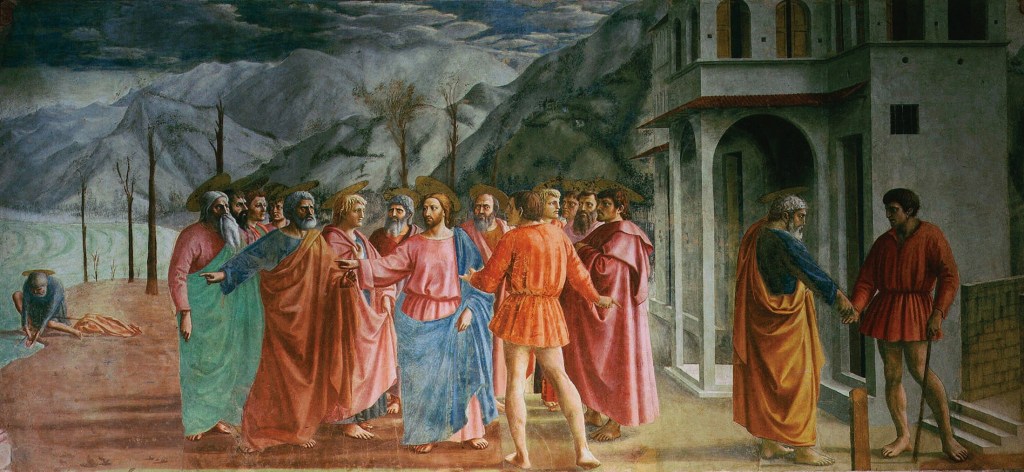
In the 15th century, artists in Florence—such as Filippo Brunelleschi and Masaccio—further developed these ideas, particularly through the refinement of linear perspective, which created a convincing sense of depth and space. Masaccio’s The Holy Trinity (c. 1427) stands as a landmark example of perspective used to enhance realism within a religious context.
Another defining feature of Early Renaissance art was the prominence of altarpieces. These large, often multi-paneled works were commissioned by churches or wealthy patrons to decorate altars and communicate theological narratives. Artists such as Fra Angelico and Piero della Francesca created altarpieces that depicted the Madonna, saints, and biblical scenes with a new emphasis on spatial realism and human emotion.
Humanism also influenced later Renaissance masters such as Leonardo da Vinci, Michelangelo, and Raphael, who built upon the foundations established during this earlier period.
Overall, the Early Renaissance was a transformative era characterized by:
- The revival of classical antiquity
- A focus on human potential and individuality
- Advances in artistic techniques such as perspective and naturalism
These developments laid the groundwork for the later achievements of the High Renaissance and continue to shape the principles of Western art today.
Notable Early Renaissance Artists
Some important artists of this period include:
- Donatello
- Masaccio
- Paolo Uccello
- Piero della Francesca
- Antonello da Messina
- Fra Angelico
- Sandro Botticelli
- Filippino Lippi
 Armchair Art Share
Leave a comment